 By gail
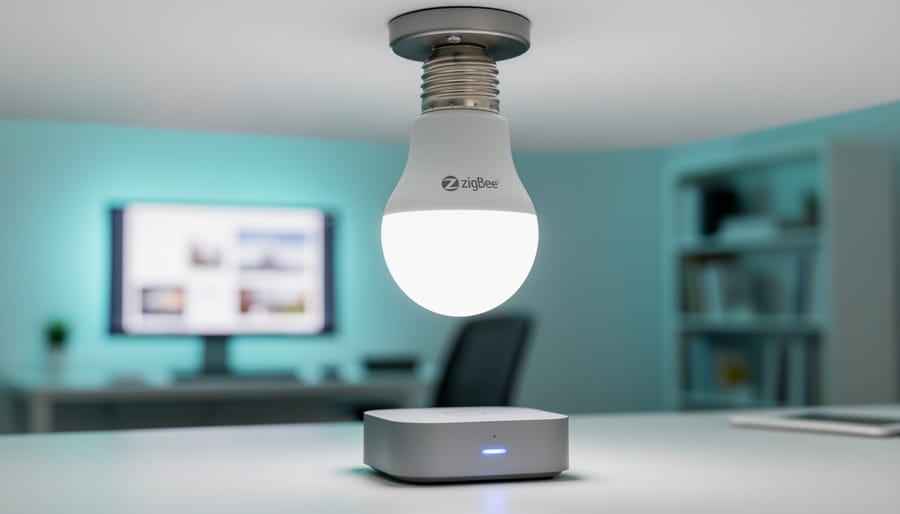
Zigbee smart bulbs are the right pick when you want reliable, low-power wireless lighting control without loading your Wi-Fi network, and the choice comes down to three things: bulb type, the hub or coordinator that runs them, and how many fixtures you plan to manage. Zigbee builds a mesh, so each powered bulb can relay signals to its neighbors, which helps coverage across offices, retail floors, and larger homes. That’s a practical advantage, and it supports the kind of energy-efficient lighting strategy that facilities teams are increasingly adopting.
In the interest of transparency, we earn a commission on some purchases made through links on this site. As an Amazon Associate I earn from qualifying purchases.
The hub matters as much as the bulb. Options like the Aeotec Smart Home Hub and Home Assistant Green give you a central point of control, and a single Smart Hub system can manage up to 64 bulbs. Compatibility has trade-offs too. Philips Hue bulbs work directly with Zigbee coordinators such as ZHA and Zigbee2MQTT, but you lose Hue app features like scenes and music sync.
Below, we explain what Zigbee requires, compare bulb types side by side, and walk through eight verified products, including the THIRDREALITY Zigbee Smart Color Bulb ZL1 and the Aqara Smart LED Light Bulb T2 GU10 so you can match the right bulb and hub to your space.
Why Zigbee Is a Smart Foundation for Brighter Lighting
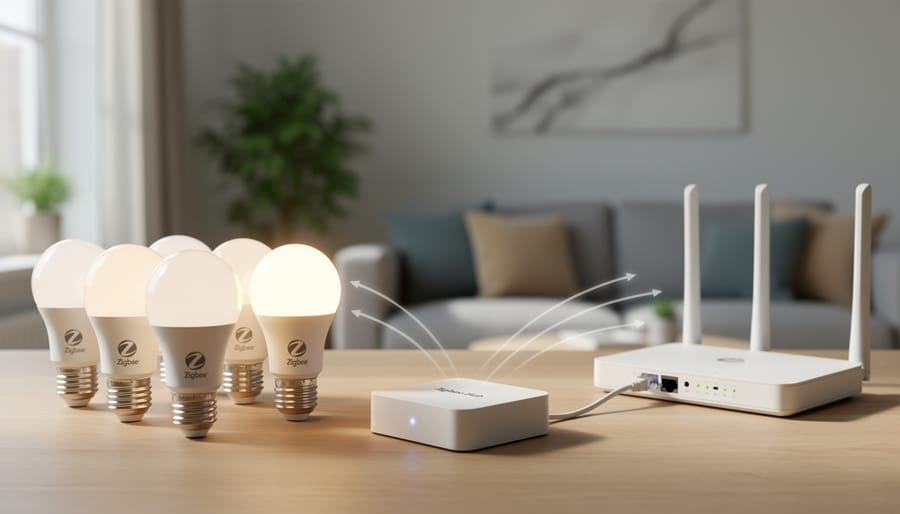
Zigbee is a low-power wireless protocol built for devices that need to stay connected without draining much energy. Instead of talking to a router over Wi-Fi, Zigbee bulbs talk to a hub or coordinator, a small controller that acts as the traffic manager for every bulb in the system. That one requirement shapes everything else, so it’s worth understanding early.
What makes Zigbee well suited to lighting is its mesh design. Mains-powered bulbs can pass signals along to one another, so a command sent to a far corner of a building can hop from bulb to bulb until it arrives. As you add bulbs, the network tends to get more capable rather than more strained. That’s useful when the goal is consistent brightness across an entire space, from a main floor to a break room or hallway.
You have a few ways to run the network. A Smart Hub is the simplest route, and a single hub can control up to 64 smart bulbs. Open-source coordinators such as ZHA and Zigbee2MQTT suit people who want local control and broader device choice. Philips Hue bulbs, for example, work directly with those coordinators, though you lose Hue app features like scenes and music sync.
Think of smart bulbs as a complementary upgrade, not a replacement for good wiring. Your existing switches and fixtures stay in place, and the bulbs add dimming, scheduling, and grouping on top.
Key Buying Factors for Smart Bulbs That Improve Brightness
Brightness, Wattage Equivalents, and Color Tuning
Lumens measure how much light a bulb actually puts out. Wattage-equivalent labels are a shorthand that tells you which old incandescent the bulb replaces. Philips Hue lists its A19 as a 75-watt equivalent and its candle bulb as a 40W equivalent, so you can read the first as a general-purpose bulb and the second as a gentler accent bulb. When you compare products, check the lumen figure on the package first and treat the wattage equivalent as a quick sanity check.
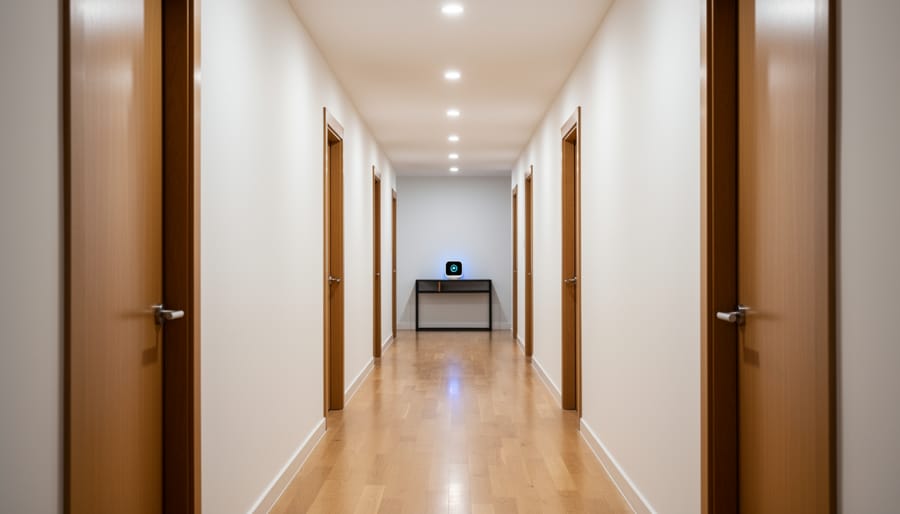
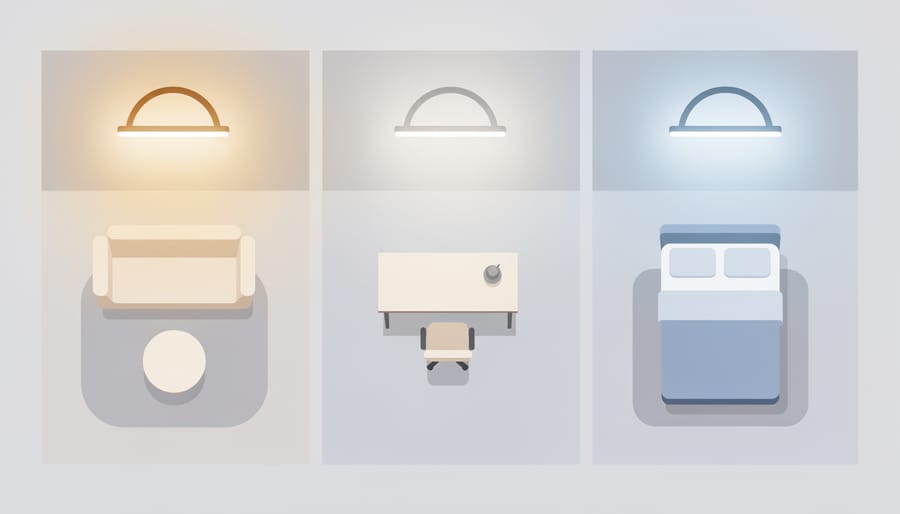
Tunable white is the setting that matters most for everyday brightness. A range of 2700K to 6500K runs from warm, relaxed light to cool, daylight-style light. Choose the warm end for lounges, hallways, and break rooms where you want a comfortable ambient glow. Choose the cooler end for desks, prep areas, and anywhere people read or focus, since crisper light makes tasks easier on the eyes.
Full color is a different decision. Color-changing bulbs, like the Hue A19 and Hue candle bulb (both listed as color changing and dimmable), add scenes and mood effects. That’s useful in lobbies, hospitality spaces, or a media room. For plain work and living areas, soft white or tunable white delivers what you need. Pay for full color only where you’ll really use it.
Hub Requirements and Compatibility Trade-Offs
Before you buy a single bulb, decide how it will be controlled. Most Zigbee bulbs need a hub or coordinator to talk to your phone, voice assistant, or automation software. The bulb itself is only half the system.
A dedicated hub keeps things simple. In a Sengled-style setup, a single Smart Hub can control up to 64 bulbs. That’s plenty of headroom for a whole house, or for a small office, break room, and a few hallways. The Sengled Soft White A19 is a standard choice here, giving you plain, dependable soft white light without extra color features you may not need.
Compatibility gets trickier when you mix brands. Philips Hue bulbs work directly with Zigbee coordinators like ZHA and Zigbee2MQTT, which is useful if you already run an open-source setup. The trade-off is real, though. Pair Hue bulbs this way and you lose Hue app features such as scenes and music sync. The bulbs still dim and switch, but the extras tied to the Hue ecosystem stay behind.
The practical rule is to match the bulb to the ecosystem before you buy. Pick your hub or coordinator first, confirm the bulbs you want are supported, and decide whether brand-specific app features matter to you. That one check prevents most of the frustration later.
Types Compared: Bulb Shapes, Color Options, and Hub Styles

Zigbee bulbs come in a handful of shapes, color options, and hub styles, and sorting them before you shop keeps the decision simple. Start with the fixture, then the light quality you need, then the gateway that will run it all.
The A19 is the standard household bulb and the easiest place to begin. Sengled’s Soft White A19 is a good example of a plain, single-color option. BR30 floods push light wider and suit recessed cans, GU10 bulbs fit spot and track fixtures, and E12 candle bases appear in decorative fittings. If you’re planning around ceilings, our guide to smart bulbs for ceiling lights goes deeper on fit and coverage.
| Type | Best Use | Color Capability | Hub/Coordinator Consideration |
|---|---|---|---|
| A19 | General room and desk lighting | Soft white, tunable white, or color | Needs a Zigbee hub or coordinator |
| BR30 flood | Recessed cans, wider spaces | Often RGB or tunable | Hub required |
| GU10 spot | Accent, task, and track lighting | Commonly tunable white | Confirm ecosystem match |
| E12 candle | Chandeliers, sconces, decorative fixtures | Dimmable, often color changing | Hub required |
| Multi-protocol hub | Mixed device setups | Not applicable | Handles several protocols in one gateway |
| Open-source hub | Local control and customization | Not applicable | Uses coordinators such as ZHA or Zigbee2MQTT |
On color, soft white gives you a fixed, comfortable tone. Tunable white lets you shift from warm to cool depending on the task, and RGBCW adds full color on top. Reserve color for spaces where it earns its keep. It’s one tool within broader light layering where ambient, task, and accent sources work together.
Hubs fall into three camps: multi-protocol gateways, open-source platforms, and brand bridges. Philips Hue bulbs work directly with coordinators like ZHA and Zigbee2MQTT, but you lose Hue app features such as scenes and music sync. Capacity matters too, since a Smart Hub system can control up to 64 bulbs.
Our Recommendations: Eight Zigbee Bulbs and Hubs Worth Considering
The eight picks below pair bulbs with the hubs and gateways needed to run them, because a Zigbee bulb is only as useful as the controller behind it. Four are bulbs and four are hubs or gateways, and we cover them in that grouped order. Ratings and availability reflect current listings at the time of writing, so check them again before you buy. Use the overview to compare at a glance, then read each entry for fit and trade-offs.
| Product | Category | Customer Rating | Availability |
|---|---|---|---|
| THIRDREALITY Zigbee Smart Color Bulb ZL1 | Bulb | 4.3 out of 5 | In stock |
| THIRDREALITY Smart Color Bulb ZB3 4Pack | Bulb | 4.4 out of 5 | In stock |
| Aqara Smart LED Light Bulb T2 GU10 | Bulb | 4.1 out of 5 | In stock |
| Zigbee E12 Smart RGBCW Candle Bulb 5W | Bulb | 4.7 out of 5 | In stock |
| Aeotec Smart Home Hub | Hub | 4.2 out of 5 | In stock |
| Home Assistant Green | Hub | 4.4 out of 5 | In stock |
| Lutron Caseta Smart Hub | Hub | 4.6 out of 5 | In stock |
| Tapo Smart Hub H100 | Hub | 4.5 out of 5 | In stock |
Aeotec Smart Home Hub: A Multi-Protocol Gateway for Mixed Setups

The Aeotec Smart Home Hub works as a SmartThings hub and acts as a Z-Wave, Zigbee, and Matter gateway in one unit. It also supports Alexa and Google Assistant and connects over WiFi. That mix makes it a practical fit for buyers who already run, or expect to run, devices on more than one protocol.
If your building has Zigbee bulbs today and Z-Wave sensors or locks tomorrow, one gateway keeps everything in a single system instead of separate bridges and apps. That cuts down on clutter and makes scenes and schedules easier to manage across device types.
Customer feedback is solid: the hub is rated 4.2 out of 5 from 2,145 customer ratings, and it’s currently in stock. For a facilities manager planning a phased rollout, that breadth is worth weighing against simpler, single-protocol hubs.
THIRDREALITY Zigbee Smart Color Bulb ZL1: Tunable Color for Flexible Rooms

The THIRDREALITY Zigbee Smart Color Bulb ZL1 is an A19 RGBCW bulb that rates 800 lumens and offers tunable white from 2700K to 6500K. It’s sold as a 4-pack, which makes it practical for outfitting a room or a small office zone in one go. It’s currently in stock and rated 4.3 out of 5 from 655 customer ratings.
Its main strength is ecosystem flexibility. It’s listed as compatible with Home Assistant (ZHA and Z2M), SmartThings, Aeotec, Homey, Hubitat, or Echo devices with a built-in hub. That breadth matters because you aren’t locked into one vendor’s app. If you later switch coordinators or expand into a mixed setup, the bulbs can come along.
This bulb suits buyers who want both everyday white light and the option of color. Cooler whites near 6500K work for task areas, while warmer tones near 2700K suit break rooms and lounges. If you only ever need plain white, a simpler bulb may be enough. Either way, confirm your hub or coordinator first.
THIRDREALITY Smart Color Bulb ZB3 4Pack: A BR30 Flood Option for Wider Coverage

The THIRDREALITY Smart Color Bulb ZB3 comes as a 4-pack of BR30/E26 flood-style bulbs, and that shape is the reason to consider it. A BR30 spreads light in a wide cone, which makes it a natural fit for recessed cans, track-style housings, and larger rooms where a standard A19 would leave dim corners. Each bulb is rated at 650 lumens and offers RGB full color, so you can use it for general wash lighting or for color accents.
A Zigbee hub is required. These bulbs don’t connect on their own, so plan the hub or coordinator before you buy. The listing names Home Assistant, SmartThings, Aeotec, Homey, Hubitat, and Alexa as compatible, which gives you real flexibility if your setup may change. It is also listed as ETL/FCC certified.
Customers rate it 4.4 out of 5 from 100 ratings, and it’s currently in stock. That’s a modest but meaningful sample. For a break room, hallway, or any space with several recessed fixtures, a 4-pack covers a small area without much planning.
Aqara Smart LED Light Bulb T2 GU10: Tunable White for Spot and Track Fixtures

The Aqara Smart LED Light Bulb T2 GU10 is a tunable white option, tuning from 2700K to 6500K, for fixtures that use the GU10 base, which is common in spot and track lighting. It’s rated 4.1 out of 5 from 18 customer ratings and is listed as in stock. That’s a small sample, so treat the score as a rough signal rather than a firm verdict.
Tunable white earns its place where you want control over the quality of light without paying for full color. A warm 2700K setting suits accent lighting on displays or a reception wall, while a cooler 6500K setting sharpens task areas like a workbench or prep counter. For buyers building a local-control setup, our guide to Smart Bulbs for Home Assistant covers how bulbs pair with coordinators. Confirm hub compatibility before buying, and pilot one fixture first.
Zigbee E12 Smart RGBCW Candle Bulb 5W Compatible: Smart Control for Decorative Fixtures

The Zigbee E12 Smart RGBCW Candle Bulb (5W) is built for fixtures that use the small candelabra base, so it fits where a standard A19 will not. You’ll find that base in chandeliers, wall sconces, and other decorative fixtures, which makes this a practical way to bring color and dimming control to ornamental lighting. It supports app, Alexa, and voice control, and it needs a Zigbee hub to work.
It’s listed at 4.7 out of 5, but that score comes from only 4 customer ratings, so treat it as an early signal rather than a proven track record. It’s in stock. Before buying, confirm your hub or coordinator supports it, then try a single bulb in one fixture. If the color and dimming behave the way you want, expand from there.
Home Assistant Green: A Local-Control Hub for Zigbee Enthusiasts

Home Assistant Green is a plug-and-play home automation hub built for people who want local control over their lighting. It’s rated 4.4 out of 5 from 950 ratings and is currently in stock.
For Zigbee bulbs, it works through a coordinator such as ZHA or Zigbee2MQTT, which lets you manage compatible bulbs directly instead of routing everything through a brand bridge. Philips Hue bulbs, for example, work directly with these coordinators.
There are trade-offs worth weighing. Pairing Hue bulbs this way means you lose Hue app features like scenes and music sync. You may also need a separate Zigbee radio to act as the coordinator, so confirm that before you buy.
It suits buyers comfortable with a bit of setup who value ownership of their system over polished vendor apps. For a small pilot, it’s a sensible way to test local control before rolling it out to more rooms.
Lutron Caseta Smart Hub Compatible with Alexa, Apple, Google Home, and More

The Lutron Caseta Smart Hub is listed as compatible with Alexa, Apple, Google Home, and other platforms, which makes it easy to fit into a voice or app setup you may already have. Shoppers rate it 4.6 out of 5 across 1,968 customer ratings, and it is currently in stock.
One point deserves care. This is a hub built for Lutron’s own ecosystem, so don’t assume it will control third-party Zigbee bulbs. Before you buy, confirm that it works with the specific bulbs you’ve chosen, and don’t rely on the platform names alone.
If your project mixes bulb types, plan the hub around the bulbs rather than the other way around. The same checking habit applies when you expand later, whether that means adding outdoor smart bulbs or pairing LED light strips with your existing controls.
Tapo Smart Hub H100 with Built-in Chime: A Compact Hub for Simple Setups

The Tapo Smart Hub H100 is a compact hub with a built-in chime, and it needs a 2.4GHz Wi-Fi connection to run. It holds a 4.5 out of 5 rating from 911 customer ratings and is currently in stock.
It suits smaller setups, such as a single office, a break room, or a modest home, where most devices already sit inside the Tapo ecosystem. One small gateway keeps things simple, and the chime adds a handy audible alert without extra hardware.
Check compatibility before you buy, though. The listing doesn’t establish which third-party bulbs the hub will control, so don’t assume it will pair with any Zigbee bulb you already own. Confirm that your chosen bulbs are supported, and start with one or two before committing to a larger rollout.
Mistakes to Avoid When Buying Zigbee Smart Bulbs
Most Zigbee regrets trace back to a handful of avoidable decisions. Here are the ones that cost buyers the most time and money.
Buying bulbs before confirming the hub. Check which hub or coordinator you’ll run first, then shop for bulbs that pair with it. Reversing that order is how people end up with a four-pack they can’t use.
Assuming brand features survive a third-party coordinator. Philips Hue bulbs work directly with coordinators like ZHA and Zigbee2MQTT, but you lose Hue app features such as scenes and music sync. If those features matter to you, the trade-off is real.
Mismatching base and fixture. A19, BR30, GU10, and E12 are not interchangeable. Measure or read the label on your existing fixtures before ordering.
Paying for full color you won’t use. In a break room or office, soft white or tunable white usually covers the need. Save RGBCW for spaces where color adds something.
Ignoring thin review samples. A 4.7 rating from four reviewers tells you much less than a 4.4 from hundreds. Weigh the count along with the score.
Overloading the mesh. Zigbee relies on powered devices to relay signals. Too few repeaters between bulbs and the hub can mean spotty responsiveness.
Skipping a pilot. Install a few bulbs in one room, live with them for a couple of weeks, then scale up.
Zigbee Smart Bulb Questions Answered
Do Zigbee smart bulbs need a hub?
Yes, Zigbee bulbs generally need a hub or coordinator to connect them to your network and to each other. That could be a multi-protocol hub, a brand bridge, or a coordinator running ZHA or Zigbee2MQTT.
Can Philips Hue bulbs work with ZHA or Zigbee2MQTT, and what is lost?
They can. Hue bulbs work directly with Zigbee coordinators like ZHA and Zigbee2MQTT. The trade-off is that you lose Hue app features such as scenes and music sync.
How many bulbs can one Smart Hub manage?
A Smart Hub system can control up to 64 smart bulbs. Check your specific hub’s listing before planning a larger rollout.
What is the difference between tunable white and RGBCW?
Tunable white adjusts the warmth of white light, typically from warm to cool. RGBCW adds full color on top of tunable white, so it suits decorative scenes more than everyday task lighting.
Lumens measure how much light a bulb puts out, while wattage equivalents only tell you which old incandescent bulb it roughly replaces. A Philips Hue A19 listed as a 75-watt equivalent, for example, is aimed at the same job as a traditional 75W bulb.
Is a higher lumen rating always better? Not necessarily. Brighter is useful for task areas like workbenches or prep spaces, but it can feel harsh in lounge or break-room settings. Match the output to the space, and rely on dimming to fine-tune it.
Start with the hub or coordinator, because every other choice depends on it. Once that’s settled, match the bulb shape and light output to the space: a BR30 flood for recessed cans, a GU10 for spot and track fixtures, an E12 candle for decorative fittings. Choose color capability only where it adds real value. In many rooms and work areas, soft white or tunable white does the job without the added complexity.
Smart bulbs are one part of a broader lighting plan, not a replacement for good fixture placement and sensible switching. Used thoughtfully, they give you finer control over brightness across a home, small office, or break room.
The same planning mindset carries over to solar-powered and off-grid lighting, where matching the equipment to the actual need beats buying the most feature-rich option. Whatever the setup, work through compatibility, fit, and purpose in that order.
Before committing to a full rollout, start small. Install a few bulbs and your chosen hub in one room, see how they perform day to day, then expand with confidence.