 By gail
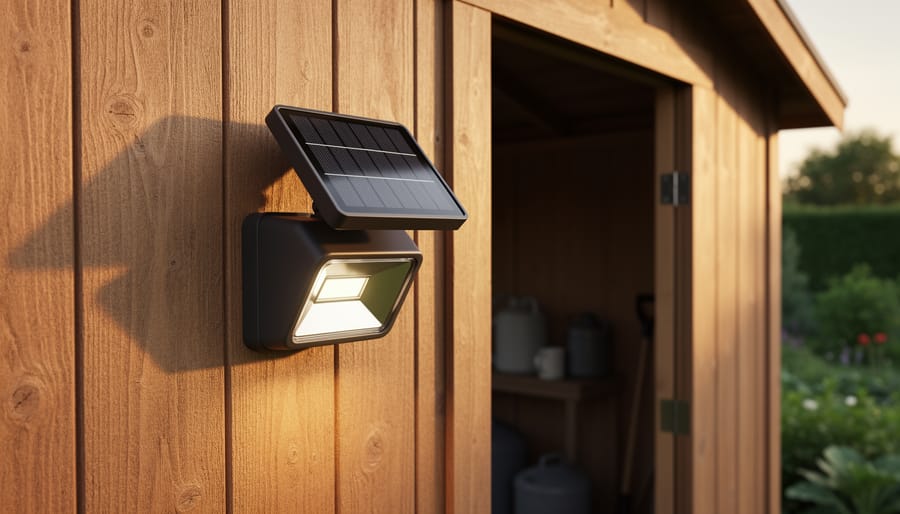
For most sheds, the right solar light is a motion-sensing wall or pendant fixture with a separate solar panel, because it lights the interior only when you need it and recharges without any wiring. String lights and lanterns suit casual spaces, while higher-output security fixtures belong where you need to see tools, stock or access points clearly.
In the interest of transparency, we earn a commission on some purchases made through links on this site. As an Amazon Associate I earn from qualifying purchases.
That choice matters more for commercial and industrial sites than it might seem. Storage sheds, maintenance outbuildings and remote equipment stores often sit far from the main electrical supply, and trenching a cable for a few fixtures rarely makes sense. Solar sidesteps that cost, runs independently of the grid, and fits neatly into a broader plan for energy-efficient lighting across your property.
Not every unit performs the same, though. Listings for shed lights show real differences in panel design, sensor coverage, ingress protection and mounting style, from IP65 waterproofing to 120-degree motion detection. Matching those features to how the shed is used is the whole game. Think in terms of light layering: a bright task light inside, a sensor-activated fixture at the door, and softer ambient lighting where it helps.
This guide explains how the technology works, what to weigh before buying, how the main types compare, and which products are worth a closer look.
How Solar Shed Lighting Works: A Quick Primer
A solar shed light is a simple chain of three parts working in sequence: a photovoltaic panel, a rechargeable battery and an LED fixture. During the day, the panel turns sunlight into electricity and stores it in the battery. When darkness falls, a light sensor tells the fixture to draw on that stored energy and switch on.
Most shed lights run in one of two ways. Dusk-to-dawn models glow automatically through the night, which suits entrances and perimeters. Motion-triggered models stay dim or off until a sensor detects movement, then brighten at full output, conserving battery for when the light is actually needed. Many fixtures also offer several lighting modes, and some add a remote or pull string so you can control them without a ladder.
The reason this setup works so well is the LED. Because LEDs convert a high share of their power into light rather than heat, a small panel and battery can keep a fixture running through the night. That same principle drives the gains described in our look at LED efficiency in commercial buildings, and it’s why solar has become practical at a shed scale.
The practical payoff is location. A shed at the bottom of the garden, or a workshop with no wiring, would normally mean trenching cable and paying an electrician. Solar skips that entirely. It’s the same logic behind remote power systems at commercial and industrial sites: generate and store energy where you need it, with no cable run required. For a homeowner or a small facilities manager, that means light where wiring is impractical.
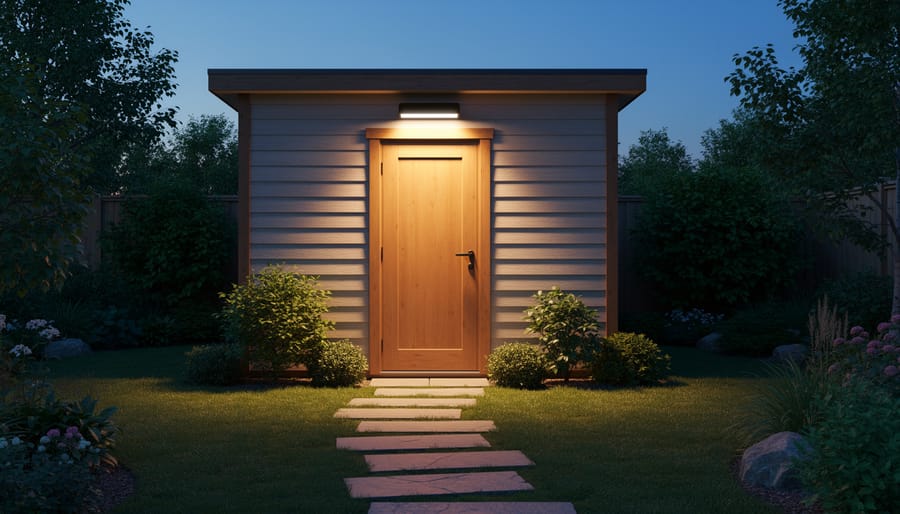
Key Buying Factors for Shed Solar Lights
Brightness, Color Temperature and Coverage
Lumen figures on solar shed lights vary widely, so treat them as a starting point rather than a promise. Current listings show the spread: a Lepro model is sold at 1000LM, another listing shows 2000LM, and a Walmart pendant listing claims 8000LM. A small storage shed that only needs a quick look inside doesn’t call for the top of that range, while a workshop where you read labels or cut stock will benefit from more output. Match the claim to the job, and remember that advertised lumens on solar fixtures are often peak figures that depend on a full battery and the chosen lighting mode.
Color temperature shapes how that light feels in use. The 2000LM listing pairs its output with 6500K, a cool daylight tone that renders edges and colors crisply, which suits task work like sorting hardware, sharpening tools or checking small parts. Warmer tones suit exterior accents, such as lighting a door or wall, where you want a softer look instead of a harsh glare.
Coverage matters as much as raw brightness. A single fixed fixture lights a limited zone, so a larger shed may be better served by a multi-head unit or a pendant hung near the center.
Sensors, Modes and Weather Protection
Motion sensing is the feature that makes solar shed lighting practical. A fixture that stays dim until someone approaches saves battery for the hours you need it, and a wide detection angle matters more than raw range for door and side-wall mounting. Some wall lights, such as the Halo SWL security model, specify a 120-degree sensor, which gives broad coverage across an entry point.
Modes and remote control add flexibility. Several listings offer multiple lighting modes, with one 176LED pendant light listing five, plus a remote so you can switch settings without a ladder. Pull-string pendants are another easy option for interior use, letting you turn the light on without searching for a sensor’s trigger zone.
For anything mounted outdoors, look for an IP65 rating. It means the housing is dust-tight and protected against water jets, so rain, sprinkler spray and washing down the wall won’t compromise the electronics. Listings for dusk-to-dawn shed lights commonly cite it.
Be realistic about longevity, though. Owner reports vary on how long units keep working, and a good spec sheet doesn’t guarantee a solid build. Check that seals sit flush, the panel cable is secure, and the housing feels sturdy, and keep your purchase records in case a unit fails early.
Solar Shed Light Types Compared: Pendant, Wall-Mounted, Flood and String
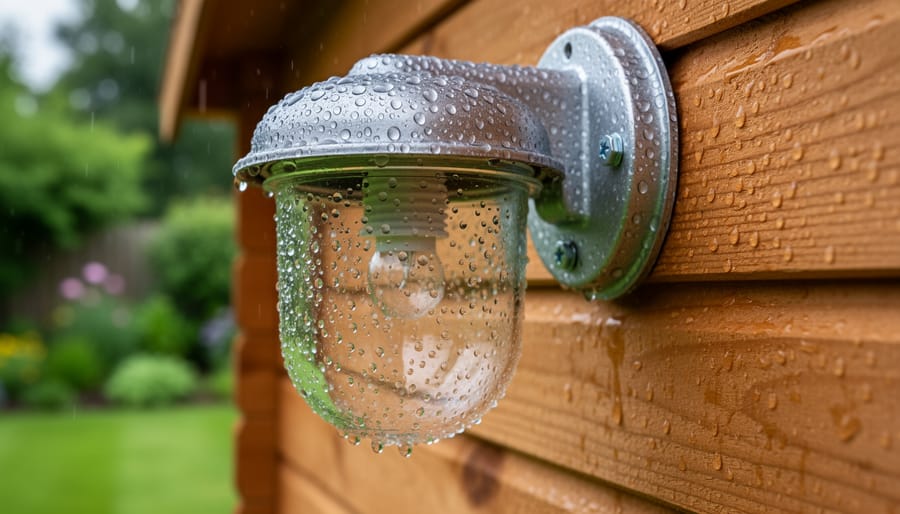
Not every shed needs the same fixture. The right style depends on whether you are lighting a workbench, a doorway or the yard around the building.
Pendant lights suit interior task lighting. Current listings include indoor/outdoor pendant designs with pull strings or remotes, and some pair a motion sensor with several lighting modes. Hang one from a ceiling hook and you have overhead light without a single wire. Wall-mounted motion lights are the natural choice for entry security, since a sensor with a roughly 120-degree field of view can cover a door and the approach to it. Multi-head flood lights widen that coverage for larger sheds, workshops and open yard areas.
String lighting is a different job entirely. It works for perimeter outlining and ambiance, in the same spirit as LED strip lighting used to define an edge or highlight a feature. It will not light a workbench. For flexible, grab-and-go light inside the shed, a rechargeable portable lantern fills the gaps that fixed fixtures leave. If you are weighing options beyond sheds, solar solutions for other tight, wire-free spaces follow the same logic: match the fixture to the task.
| Fixture type | Best shed use | Strengths | Trade-offs |
|---|---|---|---|
| Pendant light | Interior task lighting | Overhead coverage, pull-string or remote control | Needs a hanging point and a panel that can reach sunlight |
| Wall-mounted motion light | Door and entry security | Sensor-triggered light only when needed | Coverage is limited to the mounted side |
| Multi-head flood light | Larger sheds, workshops, yard security | Wide, adjustable coverage with several heads | Bulkier, and often more light than a small shed needs |
| String lights | Perimeter and exterior ambiance | Easy to run along eaves and fences | Decorative; not suited to focused task work |
Many sheds end up with a mix: a pendant inside, a motion light at the door, and perhaps a string along the roofline. Choosing by job rather than by brightness alone keeps the setup simple and the results predictable.
Our Recommendations: Eight Solar Lighting Options for Sheds
The eight options below come from a verified roster of solar lights and are grouped by what they do best: security at entry points, perimeter and accent lighting, and portable light for inside the shed. Each one solves a different problem, so the right pick depends on how you actually use your shed rather than on which listing looks brightest.
The star ratings and rating counts cited throughout reflect customer feedback on the retail listings. They show how buyers have responded, but they don’t replace your own check against the shed’s size, layout and sun exposure. Treat each entry as a starting point and match the product to your shed’s use case before you buy.
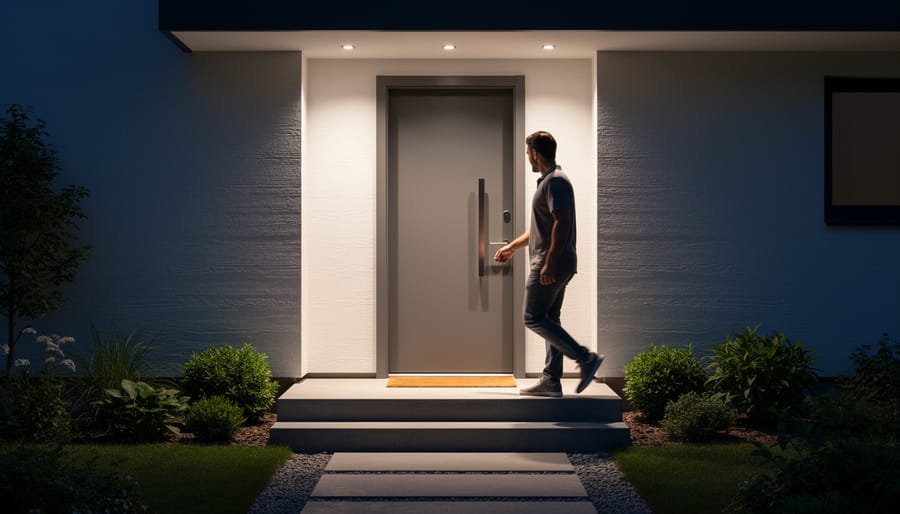
HMCITY 120 LED Outdoor Solar Lights: Motion-Sensing Wall Lights for Entry Points

The HMCITY 120 LED wall light is built for the spots on a shed where you walk up in the dark: the door, the corners and the path leading to it. It carries 120 LEDs and a motion sensor, so the light stays off until someone approaches. That saves battery for the hours when it matters. Three lighting modes let you choose between motion-triggered operation and steadier output, depending on whether you want security or a gentle glow.
Weather protection is covered by IP65 waterproofing, which is the rating you want on any fixture mounted outside, where rain and splashes hit it directly. The black shell blends in with most shed cladding, and the daylight white option gives a crisp, clear light that makes keyholes, steps and tools easy to see.
This is a multi-pack, listed here as a six-pack, and that shapes who it suits. One unit can cover the front door, but six lets you light the door, both side walls, the back corner and a couple of points along the garden path. Each fixture has its own panel, so you can mount them without running any wiring. That makes it a good fit for homeowners and small-site managers who want broad coverage from a single purchase.
It carries a 4.4 out of 5 rating from 69,819 customer ratings and is currently in stock.
One consideration: with that many units, panel placement matters. Mount each one where it gets direct daylight, since a unit tucked under an eave or behind a tree will charge poorly and fade early.
200FT Solar String Lights Outdoor Waterproof 72+2 LED Bulbs: Long-Run Perimeter Lighting

The 200FT Solar String Lights (72+2 LED bulbs) are the long-run option in this lineup, and they make the most sense for lighting the space around a shed rather than the work inside it. Think of them as perimeter and atmosphere lighting: a way to define a large yard, trace the edge of a shed, or give a gathering area a warm, usable glow after dark.
The listing describes a solar-powered string with a remote and a USB port, plus three dimmable light modes. The remote is handy when the strand is draped across a roofline or strung between posts, since you can change modes without reaching up to the panel. The USB port gives you a backup charging path when a run of overcast days leaves the battery short. The bulbs are described as waterproof, which is what you want for a string that will hang outdoors year-round.
Be realistic about the job. String lighting spreads a low, diffuse light across a wide area. It won’t give you the focused beam you need to find a tool in a dark corner or read a label, so pair it with a motion-sensing wall light or a pendant for those tasks. Where it earns its place is in large backyards, along fence lines, and around seating or party areas near the shed.
Customers rate it 4.4 out of 5 from 568 customer ratings, and it’s listed as in stock. If your shed sits in a big open yard and you want it visible and inviting without running a single wire, this length gives you plenty of reach.
Tuffenough Solar Outdoor Lights 2500LM 210 LED Security Lights with Remote Control: Wide-Angle Flood Coverage

The Tuffenough Solar Outdoor Lights are the widest-coverage option in this guide, and they suit sheds that need more than a single spotlight. Each unit carries three adjustable motion-sensing heads with 210 LEDs, and the listing claims 2500LM with a 270° wide angle. That spread matters on a larger shed or workshop, where one narrow beam leaves dark corners along the walls and around the doors.
The set ships as a 2-pack, which makes it easy to cover two sides of a building. Mounting one at the front entry and one on a side or rear wall gives overlapping coverage, so anyone approaching from a different direction triggers a light. A remote control and three lighting modes let you tune behavior to the job, such as a steadier setting for working outside after dark versus a motion-triggered mode for security. The IP65 waterproof rating is the right baseline for wall-mounted fixtures that sit in rain and snow all year.
Customer feedback is a good sign here. The listing shows a 4.4 out of 5 rating from 42,199 customer ratings, and it is currently in stock. That volume of ratings gives you a broader picture than a product with only a handful of reviews.
Treat the 2500LM figure as the manufacturer’s claim and judge it against your own space. A small garden shed rarely needs this much light, but a workshop, a barn-style outbuilding or a shed that backs onto an open yard will make better use of it. Place the panels where they get direct sun for most of the day, since a shaded panel will limit how long the lights run overnight.
Solar Camping Lantern: Portable Light for Inside the Shed

A collapsible solar camping lantern earns its place in a shed by doing what fixed fixtures can’t: it goes wherever the job is. Hang it from a hook, a rafter or a ceiling beam, then unhook it and carry it to the workbench, the back corner or the shelving at the far end. If you’ve ever held a flashlight in your teeth while sorting through a toolbox, you’ll see the appeal.
The listing for this Solar Camping Lantern, USB Rechargeable Collapsible Hanging Lights, shows it in stock with a customer rating of 4.5 out of 5. Its charging flexibility is the main practical advantage. You can leave it in a sunny spot to pick up daylight, or top it up over USB when the weather has been dull. That second route matters in winter, when a shed’s own solar panel may not get much help from the sky.
The collapsible build also keeps storage simple. It folds down small enough to sit in a drawer or hang on a nail between uses, so it doesn’t compete with tools for space.
Treat it as a companion to fixed lighting rather than a replacement. A lantern gives you targeted, movable light for detail work, but it won’t light a whole shed the way a pendant or wall fixture can. Pair it with one of the fixed options above and you get steady ambient light plus a flexible spot when you need it.
Solar Lights Outdoor Up and Down: Accent Wall Lighting for Shed Exteriors

The 2-pack of Solar Lights Outdoor Up and Down wall lights is built for a different job than the motion-sensing floods covered earlier. Instead of lighting a work area, each fixture throws a beam upward and downward along the wall it’s mounted on. That directional pattern washes the surface with light and outlines the structure, which makes the pair a good fit for the sides of a shed door, a front facade or a corner you want to define after dark.
Think of them as wayfinding and finish rather than task lighting. Mounted on either side of an entrance, they mark where the door is and give the shed a tidy, intentional look from the house or the yard. Because you get two in the pack, you can flank a door symmetrically or cover two separate walls without buying again.
The usual rule applies: they won’t replace a fixture that lights a bench or a tool wall. If you also want illumination for reading labels or finding a key at the lock, pair them with a motion-sensing wall light or an interior pendant. For readers weighing bulb-based exterior lighting against self-contained solar units, our guide to outdoor smart bulbs covers the wired alternative.
Customer feedback is solid: the listing holds a 4.4 out of 5 rating from 738 customer ratings, and it’s currently in stock. Choose it when appearance and visibility matter more than raw output.
Brightown 52FT Solar String Lights Outdoor Waterproof: Compact String Lighting With Extended Runtime

The Brightown 52FT solar string lights are the compact option in this group. The listing promises 30+ hours of runtime and describes the string as waterproof for outdoor use. It’s rated 4.4 out of 5 from 2,776 customer ratings and shows as in stock.
At 52 feet, this string suits framing a single shed rather than lighting a whole property. You can run it along the roofline, around the door, or across the front of a small patio or porch next to the shed. It gives you a soft, ambient glow that makes the structure easier to see after dark. It won’t light a workbench or the path to the door the way a motion-sensing flood would.
The smaller footprint is the main reason to choose it over the longer strings. A shorter run is easier to hang, simpler to tuck out of the way, and needs less wall or fence space to mount. If your shed sits close to a seating area or porch, you may not need the extra reach of a 108FT or 200FT string, and the shorter length keeps the setup tidy.
Think of it as finishing lighting rather than primary lighting. Pair it with a motion-triggered wall fixture for entry security, and use this string to add warmth and definition to the exterior.
Solar Wall Light Outdoor: 4000K Lighting for Shed Numbers and Entrances

Marking a shed’s address or door is a different job from lighting a workspace, and this is where the Solar Wall Light Outdoor, 4000K Solar Light for House Numbers earns its place. It’s built to sit beside an entrance and keep a number or doorway visible after dark, not to flood a yard.
The 4000K color temperature is the useful detail here. It’s a neutral white, sitting between the cooler 6500K daylight tones found on many shed lights and the warmer, yellowish glow of traditional bulbs. Daylight-white fixtures can look stark against painted timber or a tidy facade, while 4000K reads cleaner and easier on the eye. That matters if the shed sits in view of the house, a patio or a driveway.
Placement is simple. Mount it beside the door or on the wall nearest the approach, so the address or entry point stays legible for visitors, deliveries or anyone walking out after dark. Because it’s a solar fixture, there’s no wiring run to the shed, and it still needs a spot where the panel catches daytime sun.
Set expectations accordingly: this is wayfinding and visibility lighting, so pair it with a motion-sensing or task fixture if you need brighter light inside or around the shed. Customers have rated it 4.4 out of 5 across 295 ratings, and it’s currently listed as in stock.
Brightown 108FT 52LED Solar String Lights Outdoor: Remote-Controlled Coverage for Larger Areas
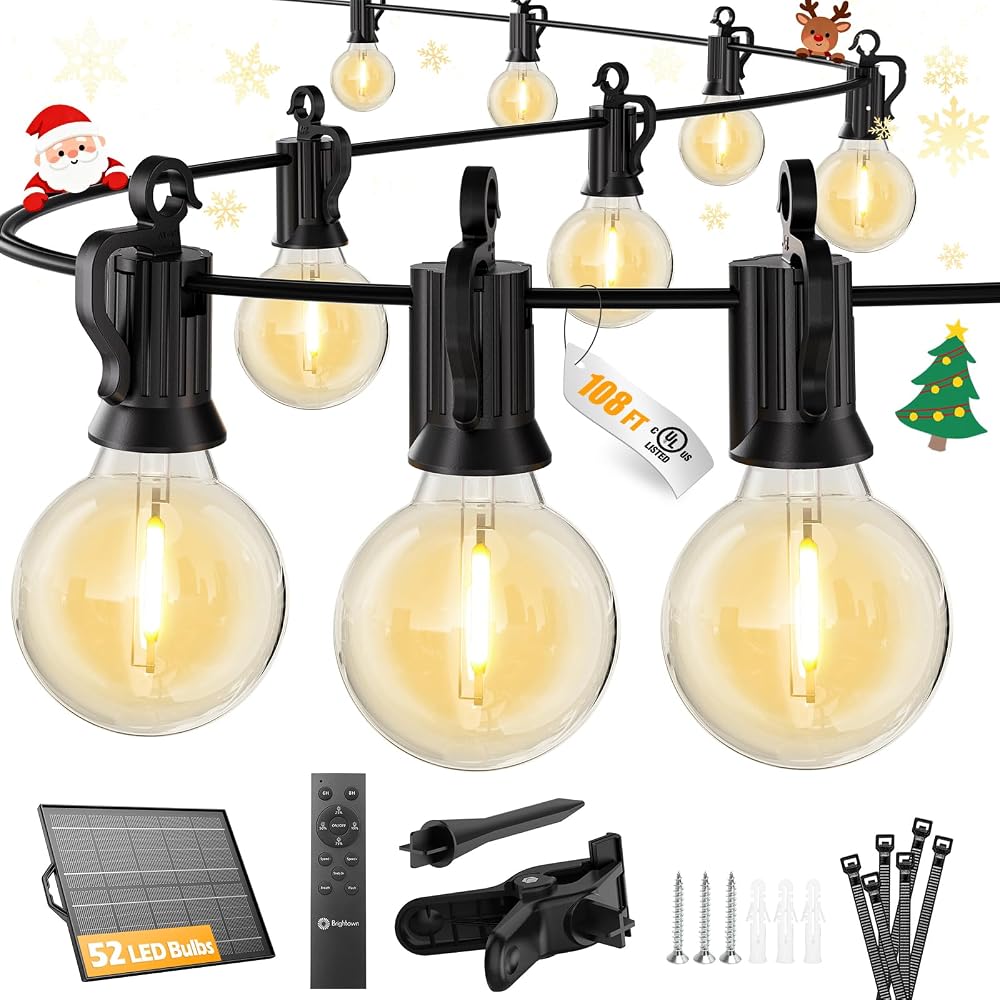
Where the shorter 52FT Brightown string suits a small porch or the frame of a shed door, the 108FT 52LED version covers more ground. That makes it a mid-length option for larger shed exteriors, fence lines and nearby seating zones, where a single short run would leave gaps or stop short of the far corner.
The listing includes a remote and a USB port, which is handy for a long string. The remote lets you change lighting settings from a distance, so you don’t have to walk the full run to adjust it. The USB port gives you a way to charge when sunlight is limited, which helps on shaded sites or in darker months. Expect this to be decorative and wayfinding light rather than a replacement for focused task lighting inside the shed.
Reach is the main difference between the two Brightown options. The 108FT string can wrap a bigger shed, follow a fence or span a seating area with fewer joins. The 52FT is the lighter choice when you only need to frame one structure. Match the length to the distance you need to cover, then plan where the solar panel will sit so it gets direct sun for most of the day.
This listing has a 4.4 out of 5 rating from 10,585 customer ratings and is shown as in stock. That volume of feedback makes it one of the most widely reviewed string options here, though it’s worth inspecting build quality on arrival and keeping your purchase records.
Mistakes to Avoid When Buying and Installing Shed Solar Lights
Most solar shed lighting problems come down to a handful of avoidable decisions made before or during installation. A little planning up front keeps the light working the way you expect.
- Placing the panel in shade: mount it where it gets direct sun for most of the day, and use a separate panel on a lead if the best light isn’t where the fixture needs to go.
- Choosing lumens without considering shed size: match brightness to the space and the job, since a small storage shed needs far less output than a workshop.
- Ignoring waterproofing: for anything mounted outdoors, look for a rating such as IP65 rather than assuming every fixture can handle rain.
- Buying decorative strings when you need task light: string lights suit perimeters and ambiance, so pick a pendant or wall fixture for reading labels or finding tools.
- Skipping panel cleaning: wipe off dust, pollen and bird droppings every so often so the panel can keep charging the battery.
One more point deserves attention. Some owners report units failing earlier than expected, and that’s a normal risk with any low-cost outdoor electronics. Before you commit, look closely at build quality: check the seals, the mounting hardware and how firmly the panel connects to the fixture. Customer feedback is useful here, so read recent reviews for patterns rather than relying on a single star rating.
Keep your receipt and order confirmation somewhere easy to find. If a fixture stops working, having a purchase record makes it far simpler to request a replacement or refund from the seller.
It also helps to test each light before you fix it in place. Hold it in the spot you plan to use, confirm the sensor triggers and the modes behave as described, and only then drill or screw it down. That small step catches dud units early and saves you from taking a fixture off the wall later.
Solar Shed Lighting FAQs
Do solar shed lights work in winter or on cloudy days?
Yes, but with reduced output. A panel still charges in overcast conditions, only more slowly, and shorter winter days mean less stored energy. Placing the panel in the sunniest spot you can find is the biggest factor in keeping runtime steady.
How many lumens does a shed need?
It depends on the job. Entry and security lighting can be modest, while a workbench or a larger workshop calls for a brighter fixture. Listings in this category range from about 1000 lumens up to 8000 lumens, so match the figure to your shed size and task rather than chasing the highest number.
Can I use solar lights inside a shed?
Yes. Several pendant-style models are sold for both indoor and outdoor use, often with a pull string or remote control. These typically pair an interior fixture with a separate panel mounted outside.
Where should I put the solar panel?
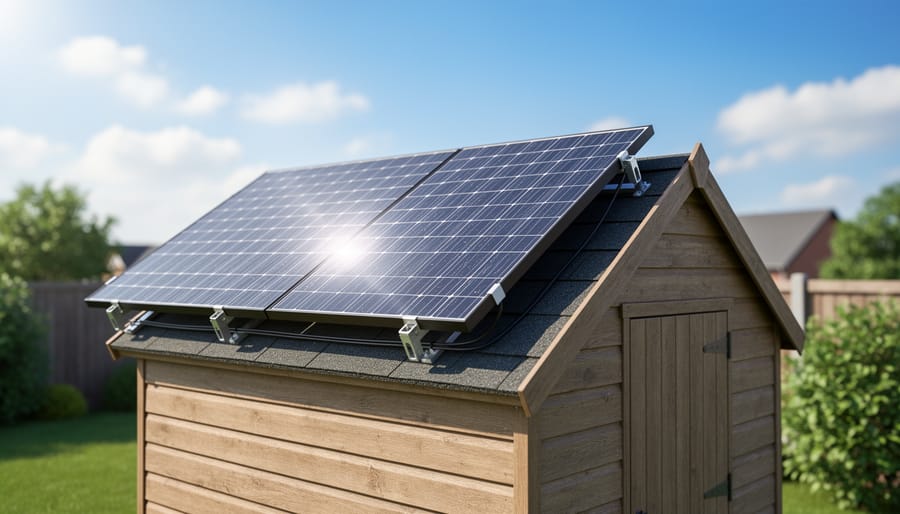
Mount it where it gets the longest direct sunlight, usually a south-facing roof edge or wall in the northern hemisphere. Keep it clear of tree shade and wipe off dust or debris now and then so it can charge properly.
None of these answers changes the core buying logic: choose the fixture type for the job first, then check that the panel can realistically be placed in good sun. If a shed is heavily shaded, a separate panel on a cable is usually more forgiving than an integrated unit, since it lets you site the light and the panel independently.
Choosing solar lighting for a shed comes down to fit, not firepower. A pendant light with a pull string is a different tool from a motion-sensing wall fixture or a wide-angle flood, and the right one is the one that matches how you actually use the space. Chasing the highest lumen figure on a listing rarely solves a problem that the wrong fixture type created in the first place.
Where running cable to a shed is impractical or costly, solar is a sensible answer: a panel, a battery and an LED deliver light with no trenching and no electrician. As solar LED technology keeps improving, these fixtures are becoming easier to match to real needs while cutting reliance on grid power. Start with the use case, shortlist the fixture styles that suit it, and your shed will be lit well for years to come.