
 By gail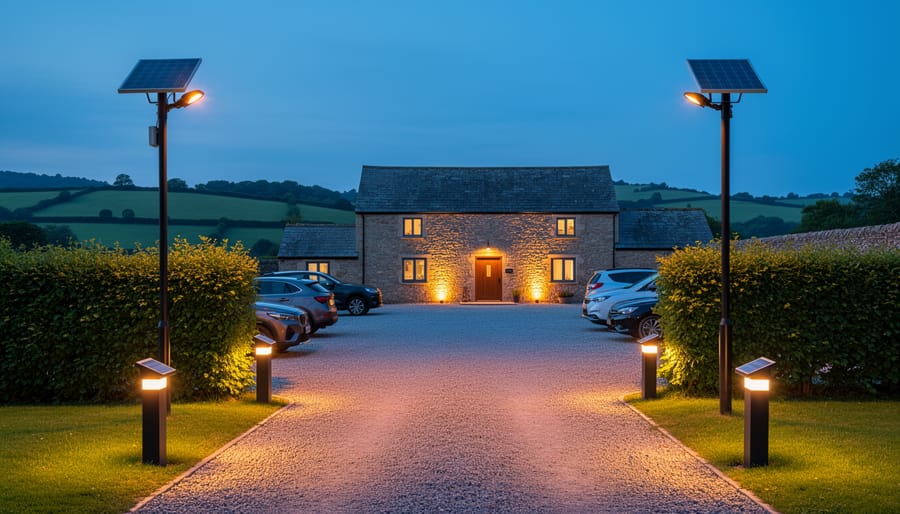
Evaluate solar lighting solutions before making purchase decisions on rural properties, development sites, or estates where grid connection costs exceed £5,000—a threshold where off-grid systems typically deliver faster payback. Property Saviour UK buyers increasingly recognize that commercial-grade solar lighting affects property valuations differently than residential systems, with quality installations adding 2-4% to commercial property values when documented with performance data.
Calculate total cost of ownership rather than upfront pricing alone. A £3,500 solar lighting system avoiding £8,000 in grid extension costs plus ongoing electricity charges represents genuine capital preservation, particularly for boundary lighting, car parks, or agricultural buildings where trenching distances make traditional connection prohibitive.
Assess battery technology specifications critically—lithium iron phosphate (LiFePO4) systems offering 3,000+ cycle lifespans justify premium pricing through reduced replacement frequency compared to standard lithium-ion alternatives requiring renewal after 18-24 months. Request independently verified autonomy ratings showing operational days without sunlight, as UK climate demands minimum 5-day backup capacity for reliable year-round performance.
Focus on installations meeting BS EN 12464 lighting standards with documented lux levels, ensuring any planning applications or future tenant requirements face no compliance obstacles that could impact marketability or rental yields.
The Hidden Costs of Traditional Lighting in UK Properties
When Grid Connection Becomes a Deal-Breaker
For many UK property buyers, the financial reality of grid connection transforms from a manageable expense into a significant barrier. Recent industry data indicates that connecting rural properties to the mains electricity supply routinely exceeds £10,000, with some installations reaching £25,000 or more depending on distance and terrain challenges.
Consider a converted barn in the Yorkshire Dales, positioned 800 metres from the nearest transformer. The property owner faced a quoted connection cost of £18,500, fundamentally altering the investment equation. Similarly, a detached annexe development in the Scottish Borders encountered £12,000 in connection fees before a single interior fitting was installed. These aren’t exceptional cases but increasingly common scenarios affecting property valuations across the UK.
The financial impact extends beyond initial connection costs. Properties with pending grid connection requirements often experience reduced marketability, with potential buyers either negotiating significant price reductions or walking away entirely. Estate agents report that properties requiring mains connection work typically sit on the market 40 percent longer than comparable connected properties.
For commercial property investors evaluating barn conversions, holiday lets, or agricultural buildings, these connection costs directly affect return on investment calculations. A £15,000 grid connection expense on a £200,000 property purchase represents 7.5 percent of the acquisition cost before generating any income.
Off-grid solar lighting solutions present a financially viable alternative in these scenarios, eliminating connection fees whilst providing immediate functionality. For perimeter security, pathways, and outdoor spaces, modern solar technology delivers professional-grade illumination without infrastructure dependencies, preserving capital for value-adding improvements rather than utility connections.
The True Cost of Outdoor and Security Lighting
Grid-powered outdoor lighting creates substantial ongoing costs that many UK property buyers underestimate. Running perimeter lighting, driveway illumination, and security systems typically consumes 3-8 kWh daily, translating to £300-£800 annually at current electricity rates. For properties requiring extensive coverage or remote locations where grid connection costs £5,000-£15,000 per pole, these expenses compound quickly.
The solar outdoor lighting benefits become evident when comparing alternatives. Initial investment in quality solar fixtures ranges from £150-£400 per unit, with premium LED security lighting systems reaching £600-£1,200 for comprehensive coverage. However, operational costs drop to zero, eliminating monthly electricity bills entirely.
For rural properties or those with challenging access, avoiding trenching and cabling saves £2,000-£8,000 in installation alone. While grid solutions offer unlimited runtime, modern solar systems with lithium batteries provide 12-14 hours of illumination, sufficient for most security and functional requirements. The payback period typically ranges from 3-7 years, making solar increasingly attractive for properties where grid extension costs exceed £3,000.
What Off-Grid Solar Lighting Actually Means for Property Buyers
Modern Systems vs. Garden Light Misconceptions
Many UK property buyers dismiss solar lighting based on experience with disappointing garden lights that barely illuminate pathways. This comparison fundamentally misrepresents commercial-grade technology. Consumer garden lights typically feature small photovoltaic panels, limited battery capacity, and low-output LEDs designed for decorative purposes rather than functional illumination.
In contrast, off-grid solar LED systems engineered for commercial applications deliver entirely different performance levels. These systems incorporate larger solar arrays with monocrystalline panels, lithium battery banks providing multi-day autonomy, and high-efficiency LED fixtures producing output comparable to mains-powered alternatives. Modern charge controllers optimize energy capture even during overcast conditions, whilst integrated sensors and smart controls maximize operational efficiency.
A common misconception suggests UK weather renders solar lighting impractical. Whilst Britain receives less solar irradiance than Mediterranean regions, professional systems are specifically calibrated for local conditions. Quality installations factor in average daily sunlight hours across seasons, sizing components to maintain consistent performance throughout winter months. Recent innovations in low-light harvesting technology have dramatically improved energy capture efficiency, making solar viable across diverse UK climates.
The performance gap between retail garden products and professional installations cannot be overstated. Commercial systems undergo rigorous testing to British Standards, carry meaningful warranties, and deliver quantifiable lux levels. For property buyers evaluating outdoor lighting requirements, understanding this distinction proves essential when assessing whether solar technology represents a credible long-term solution rather than merely a decorative addition.
Property Types That Benefit Most from Solar Lighting Solutions
Rural Properties and Agricultural Buildings
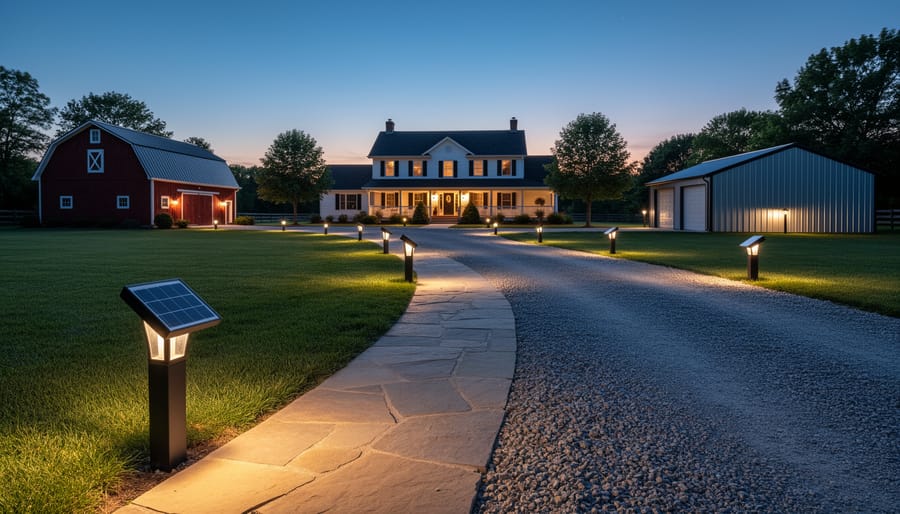
Rural properties present unique challenges where grid extension costs can quickly escalate to £10,000-£50,000 per kilometre, making off-grid solar lighting particularly cost-effective. Farmhouses with multiple outbuildings, converted barns, equestrian facilities, and agricultural complexes benefit significantly from independent lighting systems that eliminate trenching expenses and ongoing connection fees.
For equestrian centres, solar lighting enables cost-effective illumination of stable yards, outdoor arenas, and paddock areas without complex wiring infrastructure. Modern solar solutions deliver adequate brightness for early morning and evening activities whilst reducing operational costs. Similarly, agricultural storage buildings, machinery sheds, and livestock housing gain functional lighting without straining existing electrical infrastructure.
Properties with converted barns often face planning restrictions on external alterations. Solar lighting systems offer flexible installation without extensive groundworks, preserving historic character whilst meeting contemporary lighting needs. The technology also supports security monitoring across dispersed buildings, providing motion-activated illumination that deters unauthorised access whilst conserving battery capacity.
When evaluating rural properties, assess the total cost of grid extension against comprehensive solar installations. For properties with five or more outbuildings requiring illumination, solar systems typically achieve payback within 3-5 years whilst adding tangible value to agricultural and lifestyle properties seeking operational independence.
Commercial and Mixed-Use Properties
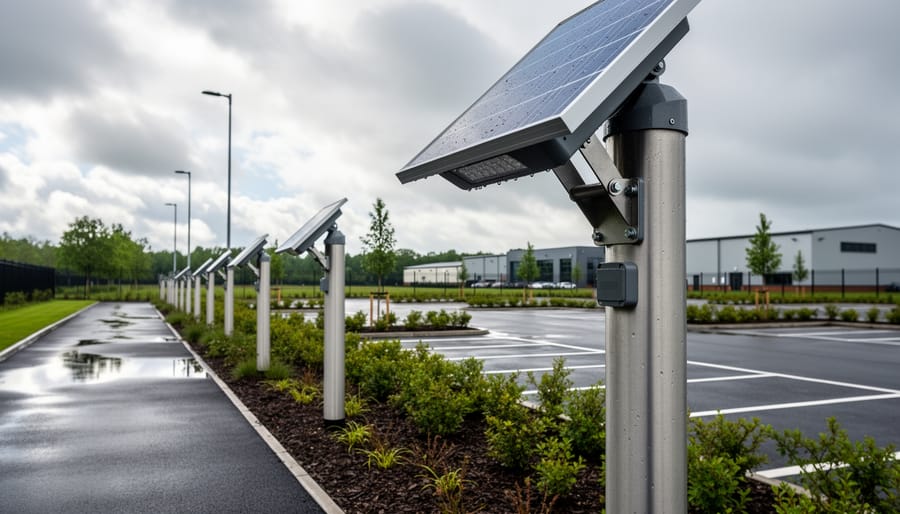
For businesses managing car parks, storage facilities, or rental properties with outdoor spaces, off-grid solar lighting delivers substantial operational savings whilst enhancing security and property appeal. Commercial solar lighting systems eliminate ongoing electricity costs and the expense of trenching for grid connection, particularly valuable for remote parking areas or peripheral storage zones where traditional wiring proves prohibitively expensive.
Multi-let properties with communal outdoor spaces benefit from reduced service charges, making units more attractive to cost-conscious tenants. Industrial estates and business parks can illuminate access roads and perimeter areas without impacting operational budgets, whilst agricultural properties gain practical lighting for yards and equipment storage without affecting existing electrical loads.
The installation flexibility allows phased deployment across expanding sites, and modern systems incorporate smart controls for adaptive lighting levels. For property investors, these installations demonstrate forward-thinking sustainability credentials whilst delivering quantifiable reductions in running costs, typically achieving payback within three to five years depending on configuration and usage patterns.
Properties with Challenging Access or Listed Status
Properties in conservation areas, those with listed status, or heritage designations frequently face strict planning restrictions that prohibit traditional electrical installations. Trenching for underground cables can damage archaeological features, disturb protected landscapes, or compromise the historical integrity of period buildings. For property buyers evaluating such assets, off-grid solar lighting presents a compliant solution that preserves value whilst meeting modern safety and security requirements.
Listed buildings often require specific consent for external alterations, and even internal electrical work may need approval from conservation officers. Solar lighting systems eliminate these concerns by requiring no mains connection or invasive groundwork. Modern photovoltaic units integrate discreetly with period architecture when properly specified, addressing both functional needs and aesthetic considerations.
Properties with challenging terrain present similar obstacles. Rocky ground, steep gradients, or areas with protected tree roots make cable installation impractical and expensive. The cost savings become particularly significant when comparing the expense of specialist excavation against self-contained solar installations that require only surface mounting.
This approach demonstrates innovation in preserving heritage whilst embracing sustainable technology. For facilities managers overseeing historic estates or commercial properties in sensitive locations, solar lighting delivers compliance, reduces installation costs, and supports environmental credentials without compromising the asset’s protected status or future market value.
The Financial Case: ROI and Property Value Impact
Upfront Costs vs. Long-Term Savings
When evaluating off-grid solar lighting for your UK property, understanding the financial trajectory over time reveals compelling advantages. Quality solar systems typically require initial investments ranging from £500 to £2,000 per lighting point, depending on specifications and site requirements. This contrasts sharply with grid connection costs, which in remote locations can exceed £10,000 to £30,000 for trenching, cabling, and infrastructure—before any electricity consumption begins.
The mathematics become particularly favourable over a 10-15 year operational period. Grid-connected commercial outdoor lighting averages £150-300 annually per fixture in electricity costs, alongside maintenance visits requiring mains power shutdowns. Solar installations eliminate these recurring expenses entirely, with premium LED components offering 50,000-hour lifespans and maintenance limited to occasional panel cleaning and battery replacement after 7-10 years.
For properties with six outdoor lighting points, grid connection and 15-year operational costs can approach £40,000, whilst equivalent solar infrastructure totals approximately £8,000-12,000 including battery replacements. This represents substantial long-term savings whilst enhancing property sustainability credentials.
Innovation in battery technology and solar panel efficiency continues improving performance-to-cost ratios. Modern lithium iron phosphate batteries deliver superior longevity compared to earlier generations, reducing lifecycle costs further. For decision-makers prioritizing both financial prudence and environmental responsibility, the upfront investment in quality solar lighting systems delivers measurable returns whilst future-proofing property assets against rising energy costs and grid dependency.
How Solar Infrastructure Affects Property Valuations
Properties equipped with established off-grid solar lighting systems demonstrate measurable advantages in today’s property market. Recent buyer surveys indicate growing preference for energy-independent features, particularly among purchasers evaluating rural or semi-rural locations where grid extensions prove costly.
From a valuation perspective, solar infrastructure contributes positively to Energy Performance Certificate ratings, though outdoor lighting systems alone won’t transform overall scores. The real advantage emerges in comparative marketing—properties with fully-functional solar lighting packages stand out against similar listings lacking this infrastructure. Estate agents report reduced negotiation friction when buyers recognise they won’t face immediate capital expenditure for outdoor illumination.
Commercial property buyers particularly value quantifiable operational cost reductions. A well-documented solar lighting system with maintenance records and performance data provides concrete evidence of reduced running costs, supporting asking price justification. This transparency appeals to facilities managers conducting due diligence on lifecycle expenses.
For residential buyers, perception centres on convenience and sustainability credentials. Properties marketed with established solar pathways, security lighting, or garden features eliminate decision fatigue around outdoor lighting design whilst demonstrating the seller’s commitment to sustainable infrastructure. These factors may not dramatically inflate valuations but certainly accelerate sales cycles and strengthen buyer confidence in properties positioned as forward-thinking investments.
What to Look for When Evaluating Solar Lighting Systems
Component Quality and Longevity Markers
Understanding component specifications enables property buyers to distinguish between investment-grade systems and products likely to underperform or fail prematurely. This knowledge proves essential when evaluating properties with existing installations or specifying new systems.
Battery capacity, measured in ampere-hours (Ah) or watt-hours (Wh), determines how many nights your lighting can operate without solar charging. Quality systems for UK climates should offer minimum 3-5 day autonomy to accommodate extended cloudy periods. Lithium Iron Phosphate (LiFePO4) batteries represent the current benchmark, offering 3,000-5,000 charge cycles compared to 500-1,000 for traditional lead-acid alternatives. This translates to 8-12 years operational lifespan versus 2-3 years, fundamentally altering lifetime costs.
LED efficiency ratings, expressed in lumens per watt (lm/W), indicate how effectively the system converts power to usable light. Premium units achieve 140-160 lm/W, whilst budget products may deliver only 80-100 lm/W. This efficiency gap directly impacts battery drain and required panel capacity.
Solar panel wattage must align with geographical location and seasonal variation. Monocrystalline panels with 18-22 percent efficiency ratings perform best in UK’s diffuse light conditions. Verify panels carry minimum IP65 ingress protection ratings and IEC 61215 certification.
Build quality markers include marine-grade aluminium housings, tempered glass lenses, and stainless steel fixings. Systems rated for -20°C to +60°C operation ensure year-round reliability. Warranty terms provide telling indicators: reputable manufacturers offer 3-5 year product warranties with 25-year panel performance guarantees, reflecting genuine confidence in component longevity.
Performance in UK Weather Conditions
Understanding how off-grid solar lighting performs in UK weather conditions is essential for making informed investment decisions. While Britain’s climate presents genuine challenges, modern solar technology has evolved significantly to address these limitations.
The UK receives approximately 60% less sunlight in winter months compared to summer, and average solar irradiance ranges from 1.0 kWh/m² daily in December to 4.5 kWh/m² in June. Quality commercial solar lighting systems compensate for this through oversized solar panels and battery storage designed specifically for low-light climates. Leading manufacturers now rate their products using autonomy periods—typically 3-5 days for UK installations—indicating how long the system operates without sunlight recharge.
During extended cloudy periods, battery capacity becomes the critical factor. Lithium iron phosphate (LiFePO4) batteries, increasingly standard in premium systems, maintain 80-90% efficiency even in cold temperatures below 0°C, unlike older battery technologies that suffered significant performance drops.
For property buyers, this translates to practical considerations. Systems rated for UK conditions typically feature 30-40% larger solar panels than Mediterranean equivalents and battery banks sized for worst-case winter scenarios. Installation orientation and tilt angles should be optimized for low winter sun angles (approximately 15-20 degrees in the UK).
Realistic expectations matter: solar lighting will perform differently across seasons, with potential dimming during particularly harsh winter weeks. For critical applications like security lighting, consider hybrid systems with grid backup capability or dual solar-mains configurations. This innovation ensures reliable year-round performance whilst maximizing sustainability benefits and reducing operational costs by up to 85% compared to mains-powered alternatives.
Planning Permissions and Building Regulations Considerations
One significant advantage of off-grid solar lighting systems is the streamlined regulatory pathway compared to mains electrical installations. For UK property buyers, understanding these requirements can inform both budget planning and installation timelines.
Most standalone solar lighting installations fall outside the scope of Building Regulations Part P, which governs electrical safety in dwellings. This is because off-grid solar systems typically operate at extra-low voltage (usually 12V or 24V DC) and remain independent of the property’s mains electrical circuits. Consequently, installations generally don’t require certification from a registered electrician or notification to Building Control, reducing both complexity and professional fees.
However, property buyers should note specific scenarios requiring attention. Solar installations on listed buildings or properties within conservation areas typically require planning permission, regardless of the system’s electrical characteristics. Additionally, if mounting larger solar arrays on roofs or prominent exterior positions, permitted development rights may apply size and placement restrictions. Ground-mounted installations usually face fewer constraints, though commercial properties should verify local planning policies.
For properties undergoing renovation or new builds incorporating solar lighting from the outset, integrating these systems into initial planning applications proves straightforward. Building Control officers increasingly recognise solar technology’s role in sustainable development, often viewing off-grid lighting favourably within broader energy efficiency strategies.
While the simplified approval process represents a practical advantage, maintaining professional installation standards remains essential. Reputable installers ensure compliance with manufacturer specifications and relevant safety standards, protecting both system performance and property insurance validity. This regulatory simplicity, combined with professional execution, makes off-grid solar lighting an accessible option for forward-thinking property investors seeking sustainable infrastructure enhancements.
Making Solar Lighting Part of Your Property Purchase Strategy
Integrating solar lighting considerations into your property purchase strategy requires methodical evaluation at each stage of the buying process. During initial viewings, assess existing outdoor illumination infrastructure and note areas requiring lighting coverage. Document the property’s orientation, identifying south-facing locations that receive optimal sunlight exposure for solar panel placement. Examine tree coverage and neighbouring structures that might create shading issues, as these directly impact solar efficiency and long-term performance.
When commissioning property surveys, request specific evaluation of potential solar installation sites. Professional surveyors can identify structural considerations for mounting equipment, existing electrical infrastructure that might complement solar systems, and any planning restrictions affecting outdoor installations. This technical assessment provides essential data for accurate cost projections and prevents unexpected complications post-purchase.
Factor solar lighting investments into your overall budget calculations strategically. For properties requiring extensive outdoor lighting, calculate the cost differential between grid extension and comprehensive solar installation. A typical off-grid property might need £3,000-£8,000 for quality solar lighting across driveways, security points, and pathways. Compare this against grid connection costs, which can exceed £15,000 for remote locations, plus ongoing electricity expenses.
Use solar requirements as a negotiation tool where appropriate. Properties with inadequate outdoor lighting infrastructure present legitimate grounds for price adjustment, particularly when grid access proves challenging. Documentation from surveys and installation quotes strengthens your negotiating position by demonstrating concrete cost implications.
Include solar lighting specifications in renovation budgets from the outset rather than treating them as afterthoughts. This integrated approach ensures proper allocation of funds and allows coordination with other property improvements. Consider phased installation strategies that prioritize essential security and access lighting initially, with aesthetic and convenience lighting added subsequently as budget permits.
Incorporating off-grid solar lighting into your property acquisition strategy represents more than an environmental statement—it’s a financially sound decision that enhances operational flexibility and long-term value. For UK property buyers evaluating sites with challenging grid access or substantial outdoor lighting requirements, this technology delivers immediate installation cost savings whilst eliminating ongoing electricity expenses for external illumination.
The strategic advantage becomes particularly evident when considering properties requiring extensive lighting infrastructure for security, pathways, or commercial operations. By integrating solar solutions from the outset, you circumvent costly electrical trenching, reduce planning complications, and create an asset that appeals to increasingly sustainability-conscious tenants and buyers. The innovation in battery storage and LED efficiency now ensures year-round reliability, even under Britain’s variable weather conditions.
Before finalizing your property investment, consultation with qualified solar specialists provides clarity on system sizing, quality specifications, and realistic performance expectations for your specific location. This professional assessment ensures your installation delivers the anticipated returns whilst avoiding common pitfalls associated with substandard equipment. The combination of reduced infrastructure costs, enhanced property marketability, and genuine sustainability credentials positions off-grid solar lighting as a strategic consideration for forward-thinking property investors seeking competitive advantage in today’s market.